

Dear Me,
Stream of Consciousness Problem Solving for the Wizard Jenkins

Dear Reader,
This isn’t something I normally do, but truth be told I am in a funk. I’ve been working on The Wizard Jenkins since 2024, and now, halfway through the story, I find myself struggling to write. Part of that is because of real life troubles—there’s a good chance I’ll be on a very unwelcome twelve-hour flight in the next 48 hours—but part of it is because I simply can’t see where this story is going anymore. Or rather, I know roughly where it’s going, but I’m struggling to see how to get there. I’ve drafted several cries for help, the most complete of which got deleted by a four-year-old (do you believe in signs?), but I’ve never been able to construct a satisfying plea because the amount of explanation required for meaningful feedback feels insurmountable.
So I’m trying something new. I found myself utterly incapable of touching the story yesterday and today, and so instead I used my time having a schizophrenic conversation with myself that I’ve decided to share. It probably lacks context, and it definitely contains spoilers, it rambles, and you are by no means required to read it. Nevertheless, I’m going to publish it with the hopes that perhaps it sparks a conversation that helps me untangle some portion of this knot. It’s all I’ve got at this point, and it’s better than sitting on my hands. And if it goes well, who knows, maybe I’ll make it a regular thing.
Here it is. Unfettered, unedited access to my over-caffeinated mind. Oh boy.
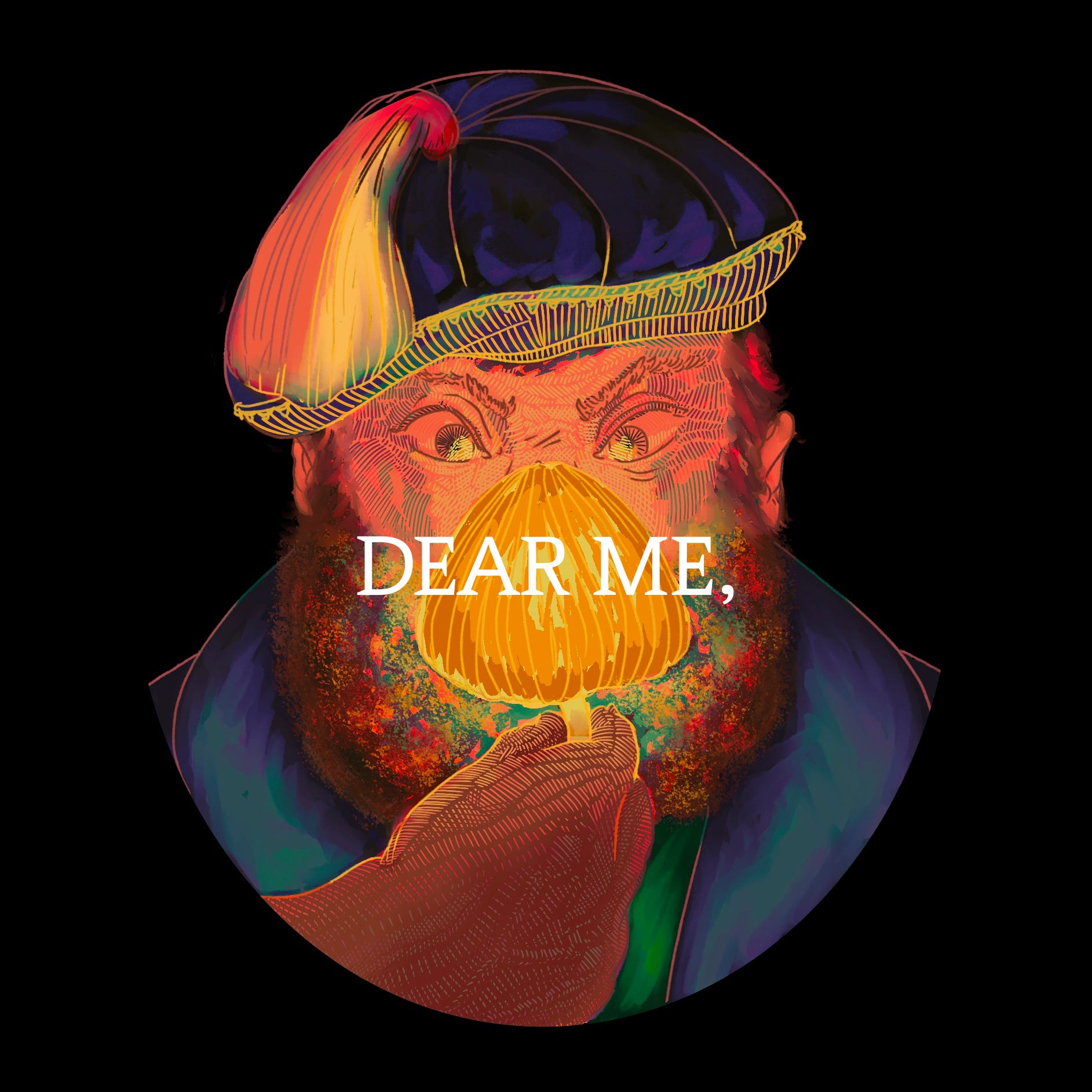
Dear Me,
What do you want out of this story? Perhaps if you understand that, you will understand how to write it.
Sincerely, Me
Dear Me,
Well, that’s a fair question. I suppose I want to write a story that makes people feel something, don’t I? I want to create a work of art that people return to. I suppose I want to contribute to the culture. It isn’t always easy to interrogate whys. Our motivations are often obscure, even to ourselves. I think it’s fair to say at this point that I’m probably running on momentum. I decided to call myself a writer, and now I write. Can you imagine not writing? I can’t. As you well know, these stories started as an attempt to build up Greyburne’s as a business, but they’ve got beyond that now, haven’t they? I hardly think about Greyburne’s at all anymore. The story’s it. Perhaps that’s just a consequence of how much time it takes to write them. I’ve deviated from the original plan. Items? What items?
Sincerely, Me
Dear Me, (DM)
But surely you want to say something. You can’t be writing just to write.
Sincerely, Me (SM)
DM,
To some extent I probably am at this point. Writers write, don’t they? Here I am doing it.
But let me try to think about your question seriously, as if it weren’t you asking it but someone else. David, for example.
What am I trying to do? Too many things, probably. The first answer that comes to mind—and not necessarily the most salient one—is that I’m trying to do what The Matrix did. What Harry Potter did. To write something meaningful. That changes the way people think. Something that they want to engage with, I suppose. I want people to put this book down and say Wow! I loved that! I want to know more about this world! These characters! And at some point, I am going to have to read that again!
Why? I don’t know! Because I admire the people who’ve done that to me? Monkey see, monkey do? Don’t ask why! It’s instinctual! A reflexive urge to create.
(And you’ll say: Fine. Enough about the why. How do you intend to do it?)
To which I’ll answer: Good bloody question. Does it come down to understanding what those books and movies did well? What had they in common? It seems to me that the trick of a good second world (is that the right term?) is revealing just enough to keep people wondering. It’s easier said than done, but what you’ve got to do is show people a glimpse; of something intriguing, something curious—and dare I say it, potentially meaningful? Are we tapping here into the religious urge? I think I’ve done that with the Wizard Jenkins. It’s Sky, but it isn’t just Sky. People have commented on the prologue. They like anima and numena in practice. Diving into that seems like a solid approach, as long as you can avoid making it too mechanical. It’s vital, crucial, paramount to maintain a degree of mystery about such things.
But you know, it wasn’t just the machines and the magic that made The Matrix (TM) and Harry Potter (HP) compelling. It was the societies that existed around them. The ships. Zion. The magical underworld. The Burrow. The MoM! And the fucking people, man. The PEOPLE. We humans love ourselves. We’re fascinated by ourselves. Make the humans in the story interesting. Lovable. Hatable. Weird. Compelling. RELATABLE. FILL the world with people. Don’t leave it sparse. Build families in readers’ heads.
Anything you’d like to add?
SM
DM,
Does the story even matter, then? What it is, I mean. Could it be anything?
SM
DM,
It could, couldn’t it? But we choose to tell stories about one thing or another, don’t we? I’ve chosen to write a story about a wizard. The motivation seems obvious. I love stories about wizards. But I’ve never wanted to write a story about a chosen one, which both TM and HP are. Perhaps that’s my contribution to the conversation. No messiahs here, my man.
Why write about someone small?
Perhaps it’s because I’m small. We all are, really. The stories of great heroes are important; they must be given how much we love them as a species. But ordinary people matter too, and they’re just as interesting. Stuart starts out quite timid, yet he does important things. Not on the planetary scale, but on the personal one.
And speaking of arbitrary decisions, we get to choose what kind of story we tell. Hopeful or nihilistic. Inspiring or…what? I remember reading The Spy Who Came in from the Cold. That ending. How bleak! How fucking miserable. And probably a fitting approach to a novel about Cold War spying, but that isn’t the energy I want to put out into the world. I’m much more in favor of Project Hail Mary-style (PHM) endings. Can’t we do good things and be rewarded for it? Perhaps the storytelling urge comes from some kind of desire to impact, in our own small way, the thrust of humanity. I don’t want to live in a bleak world, but a hopeful one, and so god damn it that’s the kind of stories I’m going to write.
That’s choosing, isn’t it? Choosing to be hopeful or to be dark? Perhaps then writing is about propagation of a world view? A mind virus a la Snowcrash. I’ve seen the effects on myself. I was in a better mood, kinder perhaps, the afternoon after PHM. We writers create experiences, and give people the opportunity to feel a certain way. Despite my gruff exterior, I want to make people feel good. Perhaps on some level I think that if I put that out there with my writing, it will come back to me somehow. I’d like that, I think.
So where are we? Curious world. Magic, because we love it. Interesting people. Small but compelling hero. Uplifting.
And I’ve neglected to note that I’m clearly wish-casting here when it comes to the kind of world I’ve conceived. I would LOVE for anima and numena to be real. Spirits of this and that. For Sky to be. This is my religious urge. It also leaves the door wide open for creativity. I get to spend hours imagining what they might look like, be like, lend my voice to the conversation—and that’s the thing we really want, isn’t it, social animals that we are? Conversation. Foolish writers, sitting alone in our rooms, when what we really want is to be having deep conversations…but then the advantage of writing is you’ve got the time to really collect your thoughts. And to communicate COMPLETE thoughts, which is so often impossible when talking to real people. How I’d love to have someone let me get to the end of my point before something I said drew them off on a tangential path. When was the last time that happened?
Complete thoughts. Right.
So what’s missing? A story? Ha! But we’ve got that. In fact, we’ve got several.
We’ve got the story of Stuart, searching for Trunkin, except that isn’t what it’s really about is it? Stuart’s story is about search for meaning and purpose. Can he find them? Has he found them? Can you find them once and lose them again? What matters? What is a good life? He’s an adventurer. A doctor. But then he isn’t. He lives in a van (bus, yes, I know, but VAN!). He has no purpose, needs no purpose, but what does he do when a friend’s in need—he helps, doesn’t he, because that’s what friends do! And does he have or need a purpose after all? Does it matter if he’s helping one person or a hundred? Does it matter if he helps anyone at all? Is a life making stick drawings in the woods just as good as one reading x-rays in a hospital? Can I even answer this question? Does Stuart succeed in his attempt to find and save Trunkin, and is that the point of his arc? (Open ended!)
And then we’ve got Trunkin, on his perennial search for TRUTH. Never satisfied, is he? First he explores the world, then an otherworld; he travels as far as he can, but far is never far enough. The answer, whatever it is, will always lie in the next thing. The bigger thing. The unattainable thing. Is he searching for God? And will he be allowed to reach the next thing, or will there be a point where he can see the goal, but not attain it? Will he be given the choice to go on, and if so, will he take it? Will he leave the world behind in favor of answers? THAT is what makes Trunkin’s arc compelling. He must be given that choice. The choice between everyone he knows and loves, between a material existence, participation in the world—and the mere possibility of greater understanding.
And Stuart’s parents, who are not a unit but individuals. Stuart’s mother, who has lived a good life but not necessarily the one she wanted—or perhaps better say not the only one she wanted; who wonders what she’s missed out on, what she’s sacrificed. Given the chance at adventure, will she revel in it, or discover that she is in fact content with the life she’s chosen? Is she capable of heroism? Does she want it? Stuart’s father, who is well satisfied with himself, but seldom satisfied with others. Can he come to accept Stuart for who he is—though Stuart himself could not say who exactly that might be—or will he only be satisfied with a son who follows in his footsteps and does as he is told?
We have the star-crossed lovers—a story I never thought I’d write—Morgwynt and Belfoss, the wind lord and the fire, (an explosive combination!) kept apart for the better part of half a millennium. Will they be reunited, and what will happen if they are?
Interjecting for a moment. That’s a lot of characters and arcs, but is it a story?
How do you mean?
I mean you’re planning to put them in a book together. They’re all acting, but are they acting together? Is it a bowl of ingredients, or is it soup?
Cohesive, you mean.
Think of it like horses and a cart. Are they all pulling in the same direction?
Do they need to?
You tell me!
Well, it is a curious question. I’m not writing a thesis paper. I don’t think a novel has to have a central point, if that’s what you’re getting at. That’s sort of the beauty of storytelling over other forms of writing. You can explore ideas without drawing explicit conclusions; you can start down paths without knowing where they lead. And because it’s art, there are no rules, really. Well-told stories come in all forms; they can be as simple or as complex as you’re willing and capable of making them. As for this story… I mean the characters are all connected, and thematically I have had the question of meaning and purpose in mind while conceiving them. The stories are all interconnected. Stuart and his parents are looking for Trunkin, who’s made a deal with Morgwynt to free Belfoss in exchange for passage to the World Tree, but in reuniting them he has the potential to cause a whole lot of damage…
I don’t know, the wind and fire story seems rather tangential to me.
Yes, maybe…but I want it in the book. It’s a story I want to tell, and it helps to illustrate what Sky is like—what’s possible in Sky—in an interesting way.
And then there’s the Dragon angle, we haven’t even touched on that. What are you trying to say with him?
Am I trying to say anything? Dragon exists because he’s interesting. Frightening. What’s interesting about this character, when you think about it, is that he’s a Big Bad, but he’s not the Big Bad. He’s not Vader, or Palpatine, or Voldemort, or Agent Smith. He is a bad actor who takes advantage of the situation Trunkin creates to devastating effect. It seems to me this is more in line with reality than many of the villains in fiction, who are set up to be the source of all ills. That isn’t how evil works in real life. There are plenty of bad actors in the real world, but you can’t attribute all that’s wrong with the world to any of them. That doesn’t mean they can’t be devastating.
And you don’t think it feels tacked on?
Now this gets to a problem I’m recognizing with the manuscript as it stands, which is that we’re seventeen chapters in, and not all of the principle characters have even been introduced yet. I’m not sure how to address it.
Well, what are your options?
I’ve already revised this story countless times, and done several full resets—the largest being when I switched from focusing only on Stuart to a supposedly omniscient narrator. I’ve got a prologue that features only Morgwynt and Belfoss. Standalone chapters that focus on Trunkin. One option is to broaden the scope of who I include as a POV character, and insert those chapters earlier on. Dragon. Morgwynt and Belfoss in particular. And Maldun, who after all is our main opposition. The challenge there is that if I reveal what they know, it lessens the impact when Stuart and Trunkin make discoveries, doesn’t it?
There is such a thing as dramatic irony. It might work, if the reader knows who’s causing trouble before the characters do.
Possibly.
That’s one option. Are there any others?
There must be at least two. One of which is to continue on the track I’m on; introduce the villains, such as they are, later in the book. Leave the reader in the dark for the first half of the story at least. And I suppose reflecting on that—though comparisons are by no means prescriptions—it’s worth noting that in TM and HP, in LOTR, we know who the bad guy is, at least in part, if not from the beginning, then thereabouts. But there are also stories where discovery plays a role; where the tale is simply allowed to unfold, and it isn’t clear that it’s working inexorably toward some final showdown. That option is open. I’m thinking of the Spawl books (Count Zero and Mona Lisa Overdrive, which I’ve just read and am currently reading), where you get individual motivations and arcs, but no clear idea where any of it’s going.
So revise the first half, give more direct attention to the other characters; or leave them to appear as they will in the latter half of the book. And the third option?
I don’t know! I felt there must be one a minute ago, but I can’t think of it now. Since it looks like I’m going to be sharing this, and maybe someone will weigh in, let’s throw in the last big problem I’m having before I run out of steam.
Shoot.
It’s the second half of the book! I’ve spent seventeen chapters on setup, on getting Stuart and Trunkin and the Jenkinses out the door; I know where they’re going to end up—in Brunanburh, with the tourney, and Maldun attacking, and Dragon waiting in the wings, but I haven’t figured out where to put them in between! I don’t just want to send them off to fill pages. Saggy middle and all that. Trunkin’s quest for Sky should be meaningful. Not just a series of baddies to overcome. Stuart and his parents need to…to have their conflicts. That’s it for them, isn’t it? Stuart’s father needs to struggle with who Stuart is. Stuart needs to struggle with it too—have doubts. Mrs. Jenkins needs to have the chance to exercise her detective’s mind, her adventuring muscles, in order to decide if it’s right for her. And I suppose Mr. Jenkins is struggling with seeing her in a different role as well. So they’ll be off chasing after Trunkin, surviving, deducing, being challenged that they may overcome. Meanwhile Trunkin races ahead, singleminded, unaware of them behind him, conscious only of his goal and that someone is trying to stop him. What can I say that’s interesting in the course of his journey? I really need to figure that out.
Asking the question is the first step in finding the answer.
Yeah, I guess so. I feel like there are more questions that need to be asked…
You are wrestling with a lot here. And you've dealt with a lot of chaos and change recently. I'm not sure what the answers are, but I hear your frustration and hope you will give yourself time. Maybe set this story aside for a while. Maybe write some flash fiction or short stories to change it up--to exercise creativity, but in smaller bites to show yourself some new stories. Wizard Jenkins will be there when you are ready to come back to it.
I absolutely love to read about other people's writing processes, so this was riveting!